Exponent Calculator
Calculate a base raised to any power, including negative and fractional exponents.
Exponent Calculator: Calculate Powers With Steps
Use this exponent calculator to raise any number to a power and see how the answer is calculated. Enter a base and exponent to solve positive, negative, zero, fractional, and decimal exponents.
This tool is useful for students checking homework, teachers explaining exponent rules, STEM learners working with formulas, and anyone who needs a quick power calculator with clear steps.
How to Use the Exponent Calculator
- Enter the base number.
- Enter the exponent or power.
- Choose your preferred decimal precision.
- Select standard or scientific notation for large and small results.
- Review the answer and the step-by-step explanation.
You can enter fractions such as 1/2 or 1/3 for fractional exponents.
What Is a Base and an Exponent?
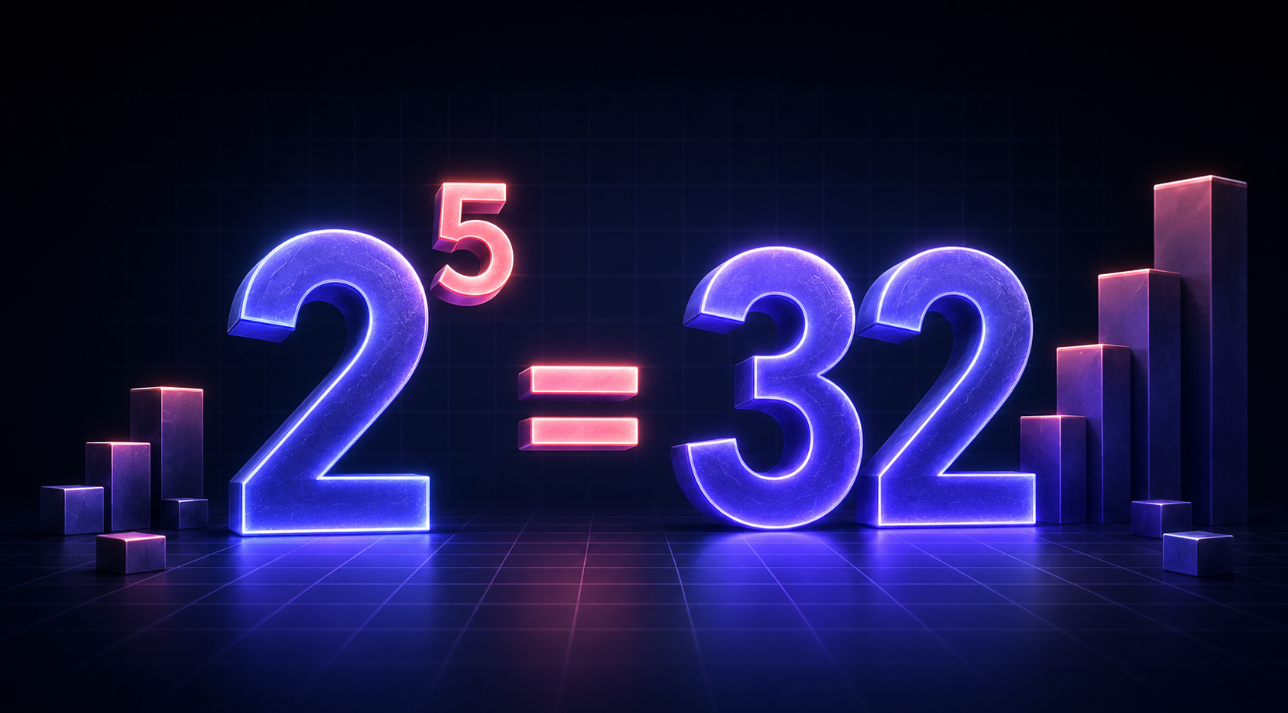
In an expression such as 2⁵, the number 2 is the base and 5 is the exponent.
The exponent tells you how many times to multiply the base by itself:
2⁵ = 2 × 2 × 2 × 2 × 2 = 32
| Expression | Base | Exponent | Result |
|---|---|---|---|
| 3⁴ | 3 | 4 | 81 |
| 5³ | 5 | 3 | 125 |
| 10² | 10 | 2 | 100 |
| 2⁸ | 2 | 8 | 256 |
Positive Exponents
A positive whole-number exponent represents repeated multiplication.
For example:
3⁴ = 3 × 3 × 3 × 3 = 81
This rule applies to positive and negative bases. Parentheses are important when the base is negative.
(−2)⁴ = (−2) × (−2) × (−2) × (−2) = 16
Without parentheses, −2⁴ is usually interpreted as −(2⁴), which equals −16.
Zero Exponents
Any nonzero number raised to the power of zero equals 1.
7⁰ = 1
100⁰ = 1
This rule applies only when the base is not zero. The expression 0⁰ is indeterminate, so the calculator identifies it instead of showing a misleading answer.
Negative Exponents
A negative exponent means that you take the reciprocal of the positive power.
2⁻³ = 1 ÷ 2³ = 1/8 = 0.125
Another example:
4⁻² = 1 ÷ 4² = 1/16 = 0.0625
Negative exponents do not automatically make the final answer negative. They tell you to move the power into the denominator of a fraction.
Fractional Exponents
Fractional exponents represent roots.
| Exponent | Meaning | Example |
|---|---|---|
| 1/2 | Square root | 16¹⁄² = √16 = 4 |
| 1/3 | Cube root | 27¹⁄³ = ∛27 = 3 |
| 1/4 | Fourth root | 16¹⁄⁴ = 2 |
| 2/3 | Cube root, then square | 8²⁄³ = 4 |
For example:
16¹⁄² = √16 = 4
27¹⁄³ = ∛27 = 3
The denominator of the fraction tells you which root to take. The numerator tells you what power to apply.
Decimal Exponents
Decimal exponents work in the same way as fractional exponents when they represent the same value.
For example:
9⁰·⁵ = 9¹⁄² = √9 = 3
The calculator evaluates decimal exponents numerically and displays the result using your selected precision.
Powers of 10 and Scientific Notation
Powers of 10 are common in science, engineering, computing, and finance.
10³ = 1,000
10⁶ = 1,000,000
10²⁰ = 100,000,000,000,000,000,000
For very large or very small answers, scientific notation keeps the result easier to read:
10²⁰ = 1 × 10²⁰
Use the scientific notation display setting when comparing large exponential values.
When an Exponent Result Is Undefined or Not Real
Some exponent expressions do not have a real-number answer.
- 0⁻¹ is undefined because it requires division by zero.
- 0⁰ is indeterminate.
- (−16)¹⁄² is not a real number because it requires the square root of a negative number.
- Negative bases with some decimal exponents may require complex numbers.
This calculator clearly explains these cases instead of returning an unexplained error.
Exponent Calculator FAQ
What is an exponent calculator?
An exponent calculator is a tool that calculates a base raised to a power. It can solve expressions such as 2⁵, 4⁻², 16¹⁄², and 10²⁰.
How do I calculate a negative exponent?
Use the reciprocal rule: a⁻ⁿ = 1 ÷ aⁿ. For example, 3⁻² equals 1 ÷ 3², or 1/9.
What does an exponent of 0 mean?
Any nonzero base raised to zero equals 1. For example, 12⁰ = 1.
Can I enter a fraction as an exponent?
Yes. Enter fractions in the form 1/2, 1/3, or 2/3 to calculate roots and fractional powers.
Why is my answer shown in scientific notation?
Scientific notation is used when a result is very large or very small, making it easier to read without a long string of zeros.